HESI A2 Study Guide 2026: Complete Exam Prep, Practice Questions & Study Plan

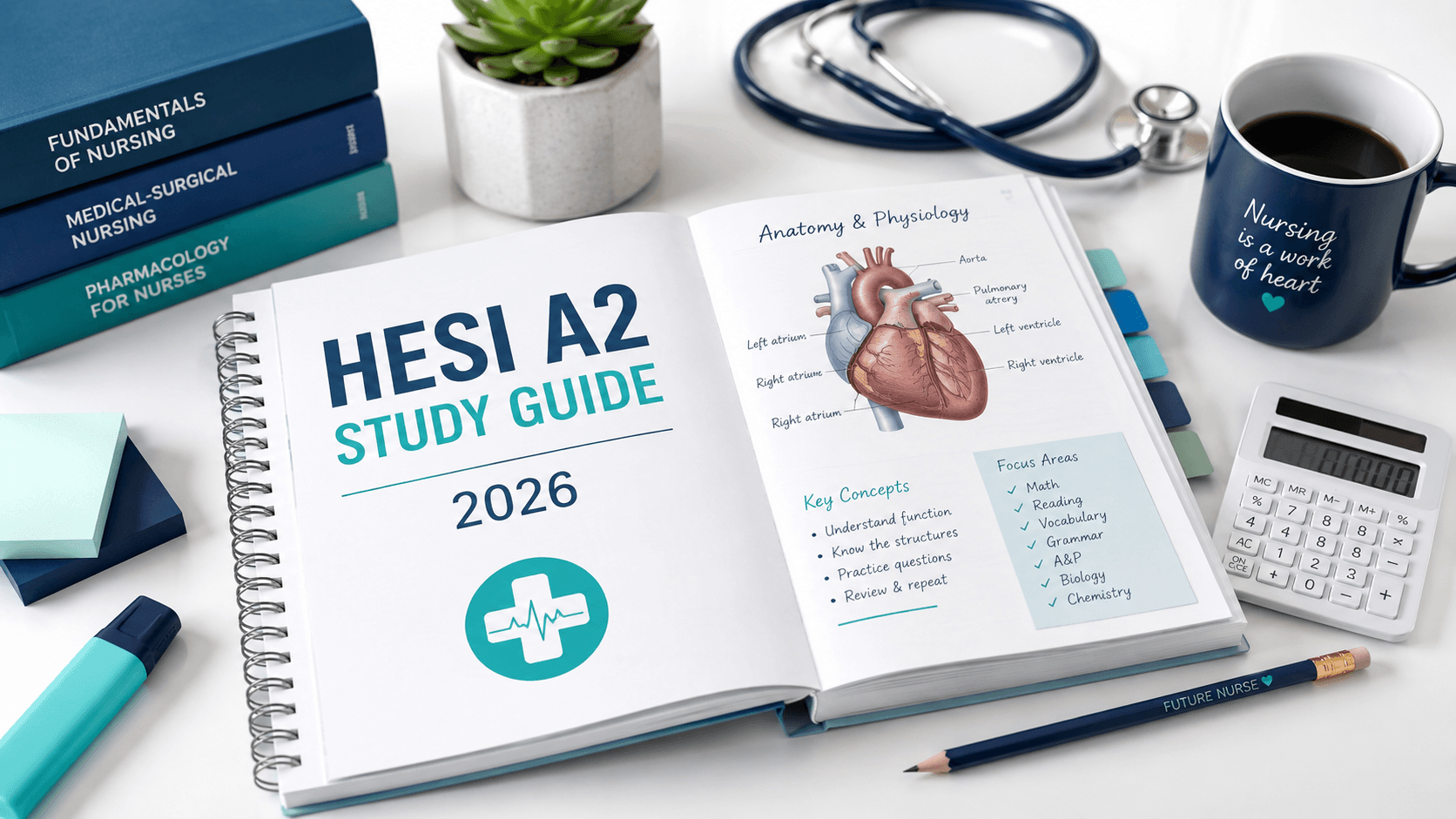
HESI A2 Study Guide: What to Study and How to Prepare
The HESI A2 can feel overwhelming because it covers several academic subjects, but you do not need to study everything equally. The first thing you should do is find out exactly which sections your nursing program requires. Schools can choose different combinations of subjects, so studying every possible HESI topic may waste valuable time. The main academic areas are Math, Reading Comprehension, Vocabulary, Grammar, Biology, Chemistry, and Anatomy & Physiology. Some programs may also include Physics, Critical Thinking, Learning Style, or Personality Style assessments.
HESI A2 at a Glance
Section | Main Things to Study |
|---|---|
Math | Fractions, decimals, percentages, ratios, proportions, conversions, algebra |
Reading | Main idea, details, purpose, inference, context |
Vocabulary | Definitions, synonyms, words in context |
Grammar | Sentence structure, punctuation, agreement, verb tense |
A&P | Major body systems, structures, functions |
Biology | Cells, DNA/RNA, genetics, mitosis/meiosis, transport |
Chemistry | Atoms, bonds, pH, reactions, solutions |
Physics | Motion, force, energy, work, waves, electricity |
Important: Chemistry and Physics should only become major study priorities if your school requires them.
1. HESI A2 Math
Math is largely about mastering basic concepts and applying them accurately. The major topics include fractions, decimals, percentages, ratios, proportions, conversions, measurements, metric units, household measurements, basic algebra, equations, word problems, order of operations, and military time.
Math Topics to Review
Fractions
Decimals
Percentages
Ratios
Proportions
Conversions
Whole numbers
Order of operations
Measurements
Metric units
Household measurements
Basic algebra
Equations
Word problems
Military time
You should be comfortable moving between fractions, decimals, and percentages. You should also understand how to solve proportions instead of simply memorizing a formula.
Proportion
If:
a / b = c / d
Cross multiply:
a × d = b × c
The best way to improve your Math score is to practice problems regularly. When you get one wrong, figure out exactly why. Was it a calculation error? A conversion problem? Did you use the wrong formula? Or did you misunderstand the question?
HESI Math rule: Practice more than you read.
2. HESI A2 Anatomy & Physiology
A&P is important because you need to know both what body structures are and what they do. Instead of trying to memorize an entire textbook, study one body system at a time and connect each structure with its function.
High-Yield Body Systems
System | What to Know |
|---|---|
Cardiovascular | Heart chambers, valves, arteries, veins, circulation, blood |
Respiratory | Air pathway, diaphragm, alveoli, gas exchange |
Nervous | CNS, PNS, neurons, brain regions, sympathetic/parasympathetic |
Digestive | Digestive pathway, liver, gallbladder, pancreas |
Endocrine | Major glands, hormones, functions |
Musculoskeletal | Bones, joints, muscles, tendons, ligaments |
Renal | Kidneys, nephron, filtration, reabsorption, secretion |
Reproductive | Major male/female organs and functions |
Cardiovascular
Know the four chambers of the heart, major valves, arteries versus veins, and pulmonary versus systemic circulation. Also review the basic components of blood: red blood cells, white blood cells, platelets, and plasma.
Remember:
Pulmonary circulation = lungs
Systemic circulation = body
Respiratory
Know the basic pathway:
Nasal passages → Trachea → Bronchi → Bronchioles → Alveoli
Also understand the role of the diaphragm and basic gas exchange.
Nervous System
Review:
Central nervous system
Peripheral nervous system
Neurons
Major brain regions
Sympathetic nervous system
Parasympathetic nervous system
Understand the basic process of receiving information, processing it, and producing a response.
Digestive System
Know the pathway:
Mouth → Esophagus → Stomach → Small intestine → Large intestine
Also know the roles of the:
Liver
Gallbladder
Pancreas
Do not just memorize the order. Understand what happens to food and nutrients during digestion.
Endocrine System
Focus on the relationship between a hormone and its function.
Hormone | Know Its Function |
|---|---|
Insulin | Review its role |
Glucagon | Review its role |
Thyroid hormones | Review their role |
Adrenal hormones | Review their role |
Growth hormone | Review its role |
ADH | Review its role |
The source specifically emphasizes understanding these hormone-function relationships rather than memorizing isolated definitions.
Musculoskeletal
Know the major bones, joints, muscles, tendons, and ligaments.
Tendon: muscle to bone
Ligament: bone to bone
Renal System
Review:
Kidneys
Nephron
Filtration
Reabsorption
Secretion
Fluid balance
Electrolyte balance
Reproductive System
Know the major male and female reproductive organs and their basic functions. Focus on understanding the structures and physiological processes rather than memorizing isolated terms.
3. HESI A2 Vocabulary
Vocabulary preparation is mainly about recognition, recall, and understanding words in context. Instead of trying to memorize hundreds of definitions in one sitting, review words repeatedly and learn how they are used in sentences.
Useful Study Method
If You... | Then... |
|---|---|
Know the word | Review periodically |
Are unsure | Review every few days |
Don't know it | Practice frequently |
For difficult vocabulary, learn the definition, a synonym when possible, and how the word works in a sentence.
Examples
Benign = not harmful or malignant
Chronic = persistent or long-lasting
Vocabulary goal: Don't just recognize the definition. Understand the word in context.
4. HESI A2 Grammar
Grammar questions test whether you can recognize correct sentence construction and language usage. Focus on the basic rules rather than trying to memorize complicated grammar terminology.
Review These Topics
Subject-verb agreement
Pronouns
Verb tense
Adjectives
Adverbs
Sentence structure
Punctuation
Capitalization
Apostrophes
Commas
Fragments
Run-on sentences
Commonly confused words
When answering a question, read the whole sentence. Check whether the subject and verb agree, whether the pronoun is correct, whether the verb tense is consistent, and whether the sentence is complete.
5. HESI A2 Reading Comprehension
Reading questions test your ability to understand and analyze information in a passage. The most important skills are identifying the main idea, finding supporting details, determining the author's purpose, making logical inferences, understanding words from context, and identifying information directly supported by the passage.
Reading Strategy
Read the question carefully.
Identify exactly what it is asking.
Go back to the passage.
Find evidence.
Eliminate answers that contradict the passage.
Choose the answer best supported by the text.
The biggest thing to remember is that the passage is the authority. Do not choose an answer simply because it sounds reasonable based on your personal knowledge or experience.
6. HESI A2 Biology
Biology preparation should focus on understanding fundamental concepts and relationships. Important areas include cell structure and function, cellular transport, mitosis, meiosis, DNA, RNA, protein synthesis, genetics, metabolism, cellular respiration, photosynthesis, enzymes, and biological organization.
Know These Comparisons
Topic | Be Able to Explain the Difference |
|---|---|
Prokaryotic vs. Eukaryotic | Cell types |
Mitosis vs. Meiosis | Cell division |
DNA vs. RNA | Genetic material |
Active vs. Passive transport | Movement across membranes |
Aerobic vs. Anaerobic | Energy processes |
Don't rely only on rereading. After studying a concept, close your notes and explain it in your own words. If you cannot explain why a process happens, review it again.
7. HESI A2 Chemistry
Chemistry is not required by every program, so confirm your school's requirements before making it a major priority. If it is required, focus on the foundational concepts rather than trying to cover every area of chemistry.
Chemistry Topics
Atoms
Elements
Compounds
Molecules
Atomic structure
Periodic table
Chemical bonds
Chemical reactions
Acids and bases
pH
Solutions
Moles
States of matter
Ionic vs. covalent bonds
8. HESI A2 Physics
Physics is also program-dependent. If your school includes it, focus on the basics:
Motion
Force
Energy
Work
Waves
Electricity
Measurements
Basic mechanical principles
Do not spend significant time on Physics before confirming that it is part of your exam.
9. How to Actually Study
A good HESI study plan should not be based on simply counting hours. Start with a diagnostic test and use your results to determine where your time should go. If you score well in Reading but poorly in Math and A&P, your study schedule should reflect that. Your weakest subjects should receive the most attention while stronger subjects are maintained through regular practice.
The HESI Study Cycle
Assess → Study → Practice → Review → Repeat
Step | What to Do |
|---|---|
Assess | Take a diagnostic test |
Study | Review weak concepts |
Practice | Complete questions |
Review | Analyze wrong answers |
Repeat | Test yourself again |
Practice questions are especially valuable because they show whether you can actually apply what you studied. When you miss a question, write down what you misunderstood and review that concept. Once your accuracy improves, start practicing under time limits.
10. Four-Week HESI Study Plan
If you have about four weeks, divide your preparation into four stages. The first week should be about finding your weaknesses and rebuilding your foundation. The second week should focus heavily on your weakest subjects. By the third week, you should be doing more mixed practice and timed sections. The final week should be about realistic test practice, reviewing mistakes, and improving pacing.
Week | Main Goal | Focus |
|---|---|---|
Week 1 | Diagnose | Practice test + foundational review |
Week 2 | Strengthen | Weak subjects |
Week 3 | Practice | Mixed + timed questions |
Week 4 | Simulate | Full practice + targeted review |
If you only have two weeks, immediately identify your weakest required sections and focus heavily on them. Increase practice questions during the middle of your preparation and introduce timed sections. During the final days, take practice tests and review mistakes rather than attempting to learn an entire subject overnight.
11. HESI Test-Taking Strategy
The number of questions you complete is less important than what you learn from them. Completing hundreds of questions without reviewing your mistakes is not as useful as completing fewer questions and understanding why you got each one wrong. Your incorrect answers can become a personalized study guide because they show exactly which concepts still need work.
Remember These Rules
Accuracy first, speed second.
Review every wrong answer.
Pay extra attention to repeated mistakes.
Don't spend most of your time on subjects you already know.
Practice under realistic time limits.
Read questions carefully.
Look for words that change the meaning of the question.
Final Takeaway
You do not need to study every HESI subject equally or spend endless hours reading textbooks. The most effective approach is targeted preparation. Find out exactly what your school requires, take a diagnostic test, identify your weakest areas, review the content, practice questions, and carefully study your mistakes.
Your preparation should follow one simple cycle:
Assess → Study → Practice → Review → Repeat
Most importantly, measure your progress by your practice-test performance, not simply by the number of hours you studied. If your practice scores consistently reach or exceed your school's required score under realistic conditions, you are in a much stronger position for test day.