HESI A2 Anatomy & Physiology: The Complete Study Guide

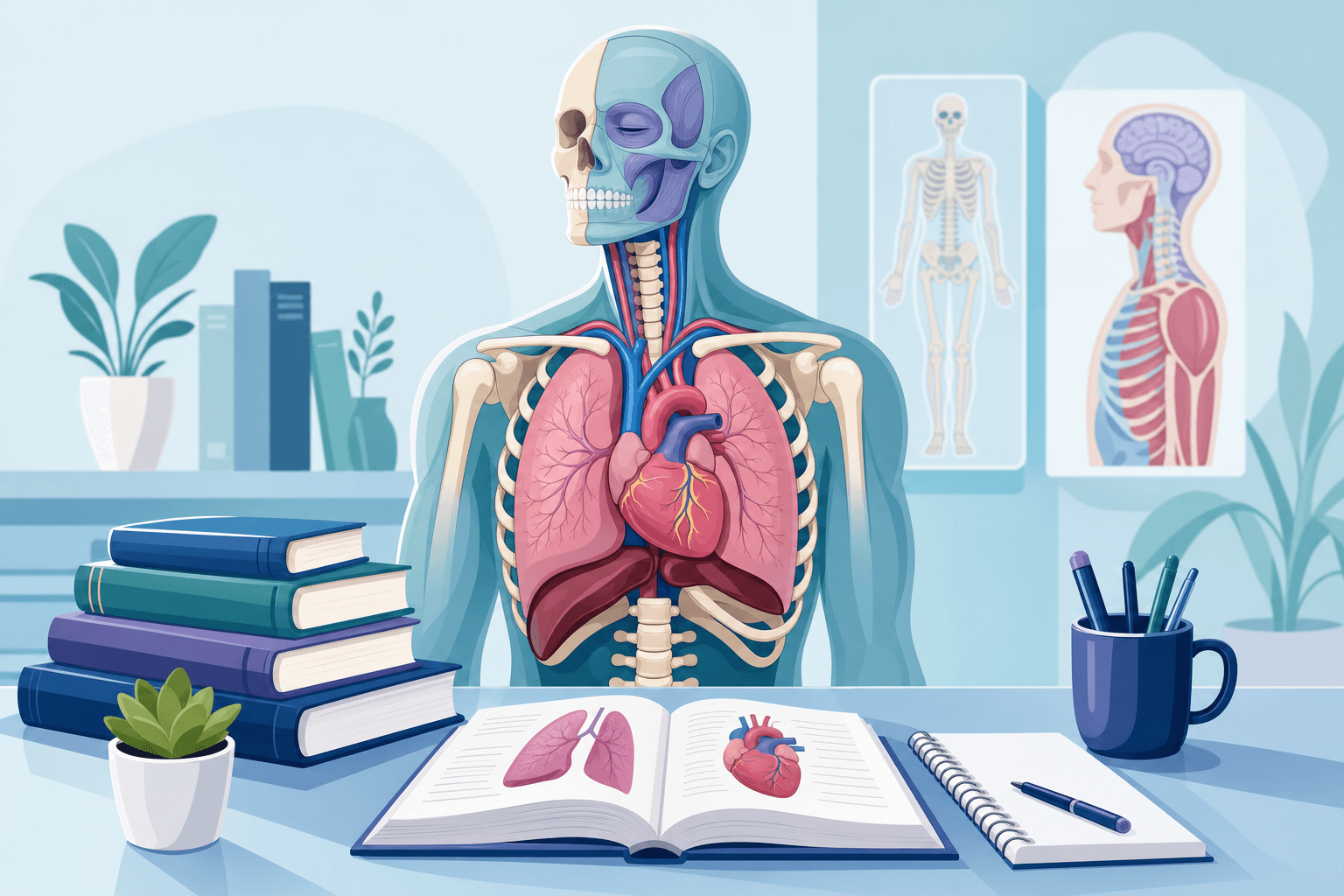
If there is one section that decides whether a nursing school application stands out, it is the HESI A2 Anatomy and Physiology test. Students consistently report it as the hardest part of the exam, and average scores on this section run well below the others. The good news is that the section is predictable. It rewards memorization, repetition, and a clear study plan far more than natural test-taking instinct.
This guide walks through everything you need to master the HESI A2 Anatomy and Physiology section: how the section works, the high-yield body systems, directional terms, a hormones and glands table, and a study strategy that actually fits your schedule. For the full picture of the exam, start with our HESI A2 study guide.
What the Anatomy and Physiology Section Tests
The Anatomy and Physiology section has 25 scored questions plus a small number of unscored pilot items, and you get about 25 minutes to complete it. That works out to roughly 50 seconds per question. Because the time per question is short, the section tests recall rather than deep reasoning. You either know that the nephron is the functional unit of the kidney, or you do not.
The section pulls from every major body system, which is exactly why it feels so broad:
- Cardiovascular, respiratory, renal, and nervous systems
- Skeletal, muscular, and integumentary systems
- Endocrine and digestive systems
- Cellular biology, tissue types, and basic genetics
- Anatomical terminology and body planes
Because only 25 questions cover all of this, every question matters. You cannot afford a weak system. According to this HESI A2 exam guide from OpenExamPrep, the section averages between 65 and 72 percent, the lowest of any section on the exam, which is why students who take it seriously pull ahead of the pack.
Directional Terms and Body Planes You Must Know Cold
Anatomical terminology appears early in nearly every A&P review and on the exam itself. These terms describe where structures sit in relation to each other, and getting them right costs you nothing if you drill them once.
| Term | Meaning |
|---|---|
| Anterior | Toward the front of the body |
| Posterior | Toward the back of the body |
| Superior | Above or toward the head |
| Inferior | Below or toward the feet |
| Medial | Toward the midline of the body |
| Lateral | Away from the midline |
| Proximal | Closer to the trunk |
| Distal | Farther from the trunk |
| Superficial | Near the body surface |
| Deep | Farther inside the body |
| Supine | Lying face up |
| Prone | Lying face down |
You should also know the three body planes: the sagittal plane divides the body into left and right, the frontal plane divides it into front and back, and the transverse plane divides it into top and bottom.
The High-Yield Body Systems
You do not need to memorize every structure in the body. You need to master the systems and facts that appear most often. Here is what to study first, one system at a time.
Cardiovascular System
Know the path of blood through the heart in order: body to the vena cava, right atrium, through the tricuspid valve to the right ventricle, through the pulmonic valve to the lungs, back through the pulmonary veins to the left atrium, through the mitral valve to the left ventricle, and out the aortic valve to the body.
Three facts earn repeated credit: the left ventricle is the thickest chamber because it pumps blood to the entire body, arteries carry blood away from the heart, and veins carry blood back to it. The heart has four valves in total, and the right side of the heart pumps to the lungs while the left side pumps to the body.
Respiratory System
Trace the air pathway: nose to pharynx to larynx to trachea to bronchi to bronchioles to alveoli. Gas exchange happens in the alveoli, the tiny air sacs in the lungs. The diaphragm contracts and moves down when you inhale, creating space for the lungs to fill. The right lung has three lobes and the left has two, because the heart takes up space on the left side.
Urinary System
The nephron is the functional unit of the kidney, and filtration happens at the glomerulus. The kidneys regulate fluid balance, electrolytes, blood pressure, and pH, and they release erythropoietin, the hormone that stimulates red blood cell production. The urine pathway is kidney to ureter to bladder to urethra.
Skeletal System
The adult skeleton has 206 bones, divided into the axial skeleton (skull, spine, ribs, and sternum) and the appendicular skeleton (limbs and shoulder and hip girdles). Red bone marrow produces blood cells, and the femur is the longest and strongest bone in the body.
Muscular System
There are three types of muscle: skeletal muscle is voluntary and striated, cardiac muscle is involuntary and striated and found only in the heart, and smooth muscle is involuntary and non-striated and found in organs and blood vessels.
Nervous System
The central nervous system is the brain and spinal cord, and the peripheral nervous system is everything else. The neuron is the basic unit, with axons sending signals and dendrites receiving them. In the brain, the cerebrum handles thought and voluntary movement, the cerebellum manages balance and coordination, and the medulla controls heart rate and breathing.
Endocrine System
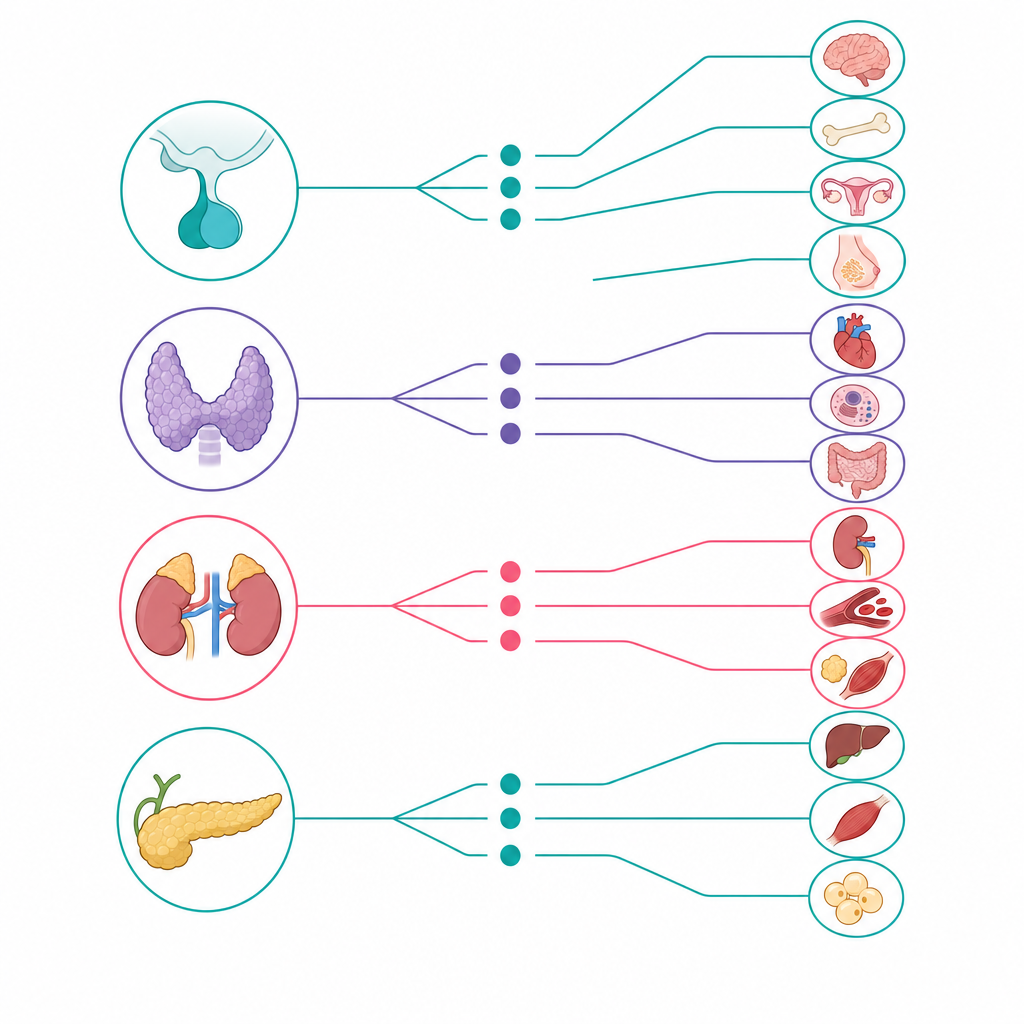
The pituitary gland is the master gland because it directs many others. The thyroid regulates metabolism, the adrenal glands release cortisol and epinephrine, and the pancreas releases insulin and glucagon to control blood sugar. A complete hormone table is below.
Digestive System
Food travels from the mouth to the esophagus, stomach, small intestine, large intestine, and rectum. Most nutrient absorption happens in the small intestine, and the large intestine absorbs water. The liver produces bile, and the pancreas releases digestive enzymes.
Integumentary System
The skin has three layers: the epidermis on the outside, the dermis below it, and the hypodermis, also called the subcutaneous layer, underneath. The skin protects the body, regulates temperature, provides sensation, and produces vitamin D.
Hormones and Glands Table
Hormone questions are some of the most reliable on the exam because the list is finite. Memorize the gland, the hormone, and the main job, and you cover most of what the section asks.
| Gland | Hormone | Main Job |
|---|---|---|
| Hypothalamus | Releasing hormones | Controls the pituitary gland |
| Pituitary, anterior | Growth hormone, TSH, ACTH, FSH, LH, prolactin | Directs growth, metabolism, stress response, and reproduction |
| Pituitary, posterior | ADH, oxytocin | ADH retains water; oxytocin triggers labor and milk release |
| Thyroid | Thyroxine (T4), triiodothyronine (T3), calcitonin | Controls metabolism; calcitonin lowers blood calcium |
| Parathyroid | Parathyroid hormone | Raises blood calcium |
| Adrenal cortex | Cortisol, aldosterone | Cortisol manages stress and blood sugar; aldosterone balances sodium and water |
| Adrenal medulla | Epinephrine, norepinephrine | Fight or flight response |
| Pancreas | Insulin, glucagon | Insulin lowers blood glucose; glucagon raises it |
| Ovaries | Estrogen, progesterone | Control the menstrual cycle and secondary sex characteristics |
| Testes | Testosterone | Controls sperm production and male characteristics |
| Thymus | Thymosin | Matures T cells for the immune system |
| Pineal | Melatonin | Regulates the sleep-wake cycle |
Cells, Tissues, and Basic Genetics
A handful of questions come from the cellular level. Know that the cell membrane controls what enters and leaves, the nucleus holds DNA, mitochondria produce energy as ATP, and ribosomes build proteins. Mitosis produces two identical body cells, while meiosis produces four gametes with half the chromosomes. The four tissue types are epithelial, connective, muscle, and nervous tissue, and the immune system defends the body with white blood cells and antibodies.
How to Study for A&P
The official HESI A2 study resources from Elsevier notes that this is a recall section, not a reasoning section, which makes it the most predictable part of the exam and the best use of your study time. Use these steps:
- Study one body system at a time and finish it before moving on. Partial knowledge of every system scores worse than solid knowledge of most of them.
- Draw or label diagrams for the heart, respiratory tract, nephron, and neuron. Labeling exercises force recall better than rereading.
- Drill the directional terms and the hormone table until they are automatic, because these are free points.
- Use spaced repetition for the memorization-heavy facts. Review yesterday's system for ten minutes before starting today's.
- Take timed practice sets under the real 50-seconds-per-question pace so the speed feels normal on test day.
When you are ready to check your progress, use our HESI A2 prep page for practice tests built around the real section format, and remember that most programs set a minimum score rather than a fixed passing bar, so check our guide to what counts as a good HESI A2 score.
Final Thoughts
Anatomy and Physiology is the section where preparation pays off the most. The content is vast, but the exam is predictable, the questions reward recall, and the highest-yield facts fit neatly into a study plan you can finish in a few weeks. Study one system at a time, drill the tables in this guide, practice under real timing, and this section can go from your biggest fear to your biggest strength.
Frequently Asked Questions
Related Posts
View all articles
CNA Measurement Questions: Intake, Output, Weight, Pulse, and Respirations
Learn how to answer CNA measurement questions on intake, output, weight, pulse, and respirations, including conversions, normal ranges, and report thresholds.

CNA Observation vs. Reporting: Which Changes in a Resident's Condition Matter Most?
Learn which changes in a resident's condition matter most for CNA observation and reporting, and how to describe them objectively so the nurse can act quickly.

CNA Delegation Questions: Knowing When to Report Instead of Acting
Learn how to answer CNA delegation questions: know your scope of practice, the five rights of delegation, and when to report to the nurse instead of acting.