HESI A2 Test Day: What to Expect and How to Prepare


Test day is where preparation pays off, and the students who score best are rarely the ones who studied the most. They are the ones who knew exactly what to expect: where to go, what to bring, how the sections are timed, and what the testing software does. Surprises on exam day cost points, and every surprise in this guide is one you can eliminate before you walk in.
This guide walks through registering, what to bring, the test center experience, section timing, the on-screen tools, and a week-by-week plan for the final stretch. For the content itself, our HESI A2 study guide covers every section in detail.
Registering for the Exam
You register for the HESI A2 through your nursing school or an approved testing center, depending on your program. Your school tells you which sections to take and often handles the registration directly, so confirm the process with admissions before you pay for anything.
Costs typically range from about $40 to $100 depending on the school and the number of sections, according to the nursing admissions guide from Westcliff University. Book your seat early, because testing windows near application deadlines fill up, and confirm the location, date, and start time in writing.
What to Bring on Test Day
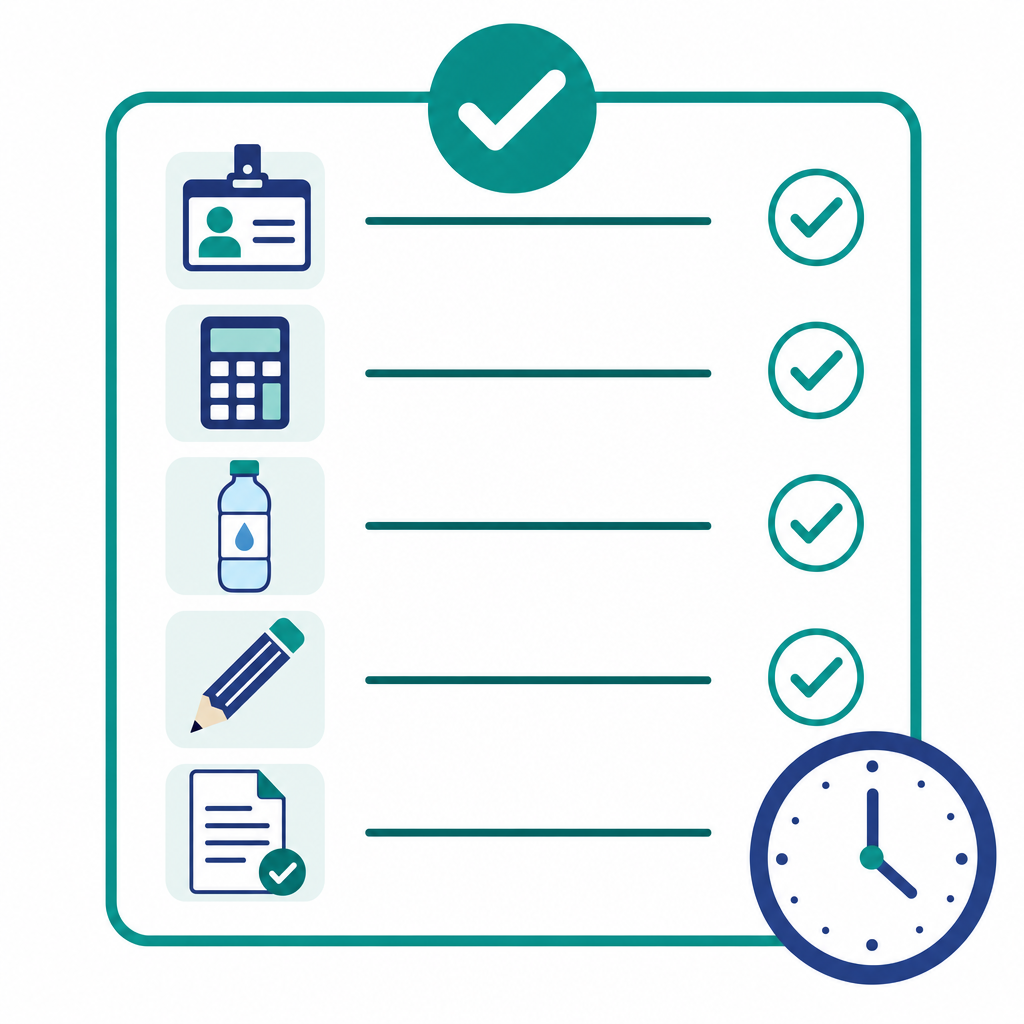
Keep the packing list simple. The items below cover almost every school's requirements:
- A government-issued photo ID, such as a driver's license or passport
- Your registration confirmation, printed or on your phone
- Payment confirmation if you paid at the test center
- A water bottle and a small snack for the break, if allowed
- A quiet outfit and layers, because testing rooms run cool
Leave everything else at home. Phones, smartwatches, calculators, study notes, and bags are typically stored in a locker or kept outside the testing room. Personal calculators are not allowed, because the exam provides an on-screen calculator for the math section.
What to Expect at the Test Center
Arrive 30 to 45 minutes early. You will check in with your ID, confirm your registration, and store your belongings before entering the testing room. The room is monitored, and you sit at a computer station with everything you need on screen.
Rules to plan for:
- You cannot bring phones, notes, or food into the testing room.
- Breaks between sections are usually allowed, but the timer for your next section starts when you return.
- Ask the proctor about break and restroom policy during check-in, so there are no surprises mid exam.
- Raise your hand for any technical issue immediately. The proctor can pause and resolve problems, but only if you report them.
Section Timing at a Glance
The sections and times below reflect the most common HESI A2 configurations, but your school decides exactly what you take. Confirm your section list before you study. The official HESI A2 study resources from Elsevier summarizes the typical counts and timings.
| Section | Typical questions | Typical time |
|---|---|---|
| Reading Comprehension | 47 scored | 60 minutes |
| Vocabulary and General Knowledge | 50 scored | 50 minutes |
| Grammar | 50 scored | 50 minutes |
| Mathematics | 50 scored | 50 minutes |
| Anatomy and Physiology | 25 scored | 25 minutes |
| Biology | 25 scored | 25 minutes |
| Chemistry | 25 scored | 25 minutes |
| Physics | 25 scored | 25 minutes |
These are approximate. Question counts can vary by school and by test version, and the numbers you see on screen are the ones that matter.
On-Screen Tools You Will Use
The testing software is simple, but it has three quirks worth knowing before test day:
- The calculator is on screen and available for the math section only. Practice with an on-screen calculator in advance, because it feels different from a physical one.
- Every section includes a few pilot questions that do not count toward your score, but you cannot tell which ones they are. Treat every question as if it counts.
- You generally cannot return to a section once you submit it, and some versions do not allow going back within a section either. Answer as you go, and do not save questions for later.
The Week Before the Exam
Use the final week to consolidate, not to learn new material:
- Day 7: take one full timed practice test under real conditions, no phone, no pauses.
- Days 6 to 4: review the questions you missed and drill your two weakest topics only.
- Day 3: review your notes, tables, and formulas once, lightly.
- Day 2: stop heavy studying. Review your packing list and confirm the test center address and arrival time.
- Day 1: rest. Sleep is the highest-yield preparation left, and recall of material like anatomy improves measurably after a full night of sleep.
The Night Before and Morning Of
The plan is simple because the goal is simple: remove friction.
- Pack your ID and confirmation the night before, and set two alarms.
- Eat a normal breakfast. A stable blood sugar level beats an experiment with a new energy drink.
- Plan to arrive 30 to 45 minutes early, and add buffer for traffic and parking.
- Leave your phone in the car or at home if you can, so the check-in process is painless.
During the Exam
Your strategy during the exam matters as much as your preparation:
- Watch the section timer, not the wall clock. Know how many minutes each section gets before you start.
- Skip the hard questions within a section if your version allows returning, and never leave a question blank, because wrong guesses cost nothing.
- Use process of elimination. Cross out obviously wrong options before choosing.
- For math, write out your work on the scratch paper provided and check your units.
- For vocabulary, your first instinct is often right. Overthinking changes correct answers into wrong ones.
After the Exam
Most schools release scores within a few days, and some provide them immediately after the test. Your score report shows each section separately, plus an overall composite if your school uses one.
When the report arrives, compare it against your program's minimums section by section, not just overall. If a single section fell short, check whether your school allows a section-level retake. If your score missed by a wide margin, take the diagnostic approach from our HESI A2 retake guide before you schedule another attempt. And once you know your target, our HESI A2 practice tests are ready for the next round.
Final Thoughts
Test day should feel routine, not dramatic. Register early, pack the night before, arrive with time to spare, and let your preparation do the work. The students who pass the HESI A2 on the first attempt are not the most anxious or the most relaxed. They are the most prepared, in both content and process, and now you have the process too.
Frequently Asked Questions
Related Posts
View all articles
CNA Measurement Questions: Intake, Output, Weight, Pulse, and Respirations
Learn how to answer CNA measurement questions on intake, output, weight, pulse, and respirations, including conversions, normal ranges, and report thresholds.

CNA Observation vs. Reporting: Which Changes in a Resident's Condition Matter Most?
Learn which changes in a resident's condition matter most for CNA observation and reporting, and how to describe them objectively so the nurse can act quickly.

CNA Delegation Questions: Knowing When to Report Instead of Acting
Learn how to answer CNA delegation questions: know your scope of practice, the five rights of delegation, and when to report to the nurse instead of acting.