HESI A2 vs. TEAS: Which Nursing Entrance Exam Do You Need?


If you are applying to nursing school, two names keep coming up in the admissions requirements: the HESI A2 and the ATI TEAS. Both exams measure the academic skills you need for a nursing program, and both can feel intimidating when you are trying to figure out which one you actually have to take.
Here is the short version: your nursing program decides which exam it requires. You rarely get to choose. That means the smartest first step is to check the admissions page of every school on your list, then build your study plan around the exact exam they ask for.
This guide breaks down how the HESI A2 and the TEAS differ across sections, questions, scoring, cost, and difficulty, so you know exactly what to expect and how to prepare.
What Is the HESI A2?
The HESI A2, short for Health Education Systems, Inc. Admission Assessment, is published by Elsevier. It is a modular exam, which means each nursing school picks the sections you must complete. Most programs require four to six sections, and some add more.
The academic sections schools can choose from include:
- Reading Comprehension
- Vocabulary and General Knowledge
- Grammar
- Mathematics
- Anatomy and Physiology
- Biology
- Chemistry
- Physics, which only some programs require
Some schools also include a Critical Thinking section, plus non-scored Learning Style and Personality Profile assessments. Because your school picks the sections, two students taking the HESI A2 can have very different exams. This is why you should confirm your exact section list before you study. If your program requires the HESI A2, our HESI A2 study guide walks through every section in detail.
What Is the TEAS?
The TEAS, short for Test of Essential Academic Skills, is published by ATI. Unlike the HESI A2, the TEAS has a fixed format. Every test taker completes the same four sections in the same order, which makes preparation more predictable.
The four TEAS sections are:
- Reading, with 45 questions
- Mathematics, with 38 questions
- Science, with 50 questions
- English and Language Usage, with 37 questions
That is 170 questions in 209 minutes, about three and a half hours. The TEAS mixes question formats, including multiple choice, multiple select, fill in the blank, hot spot, and ordered response questions. It is offered at PSI testing centers and through remote proctoring, so you have more options for where and when to take it.
HESI A2 vs. TEAS: The Key Differences
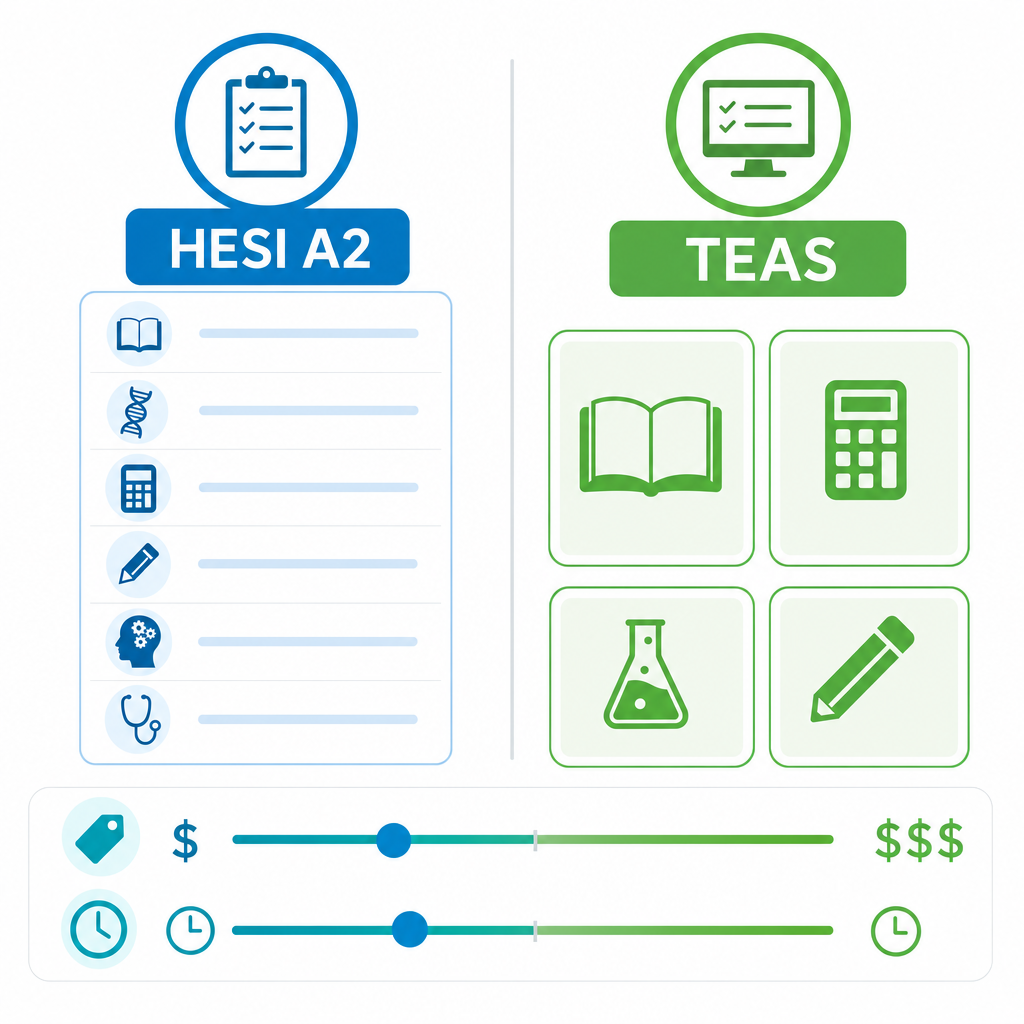
The table below summarizes how the two exams compare at a glance.
| Feature | HESI A2 | TEAS |
|---|---|---|
| Publisher | Elsevier | ATI |
| Format | Modular; your school chooses the sections | Fixed; everyone takes the same four sections |
| Sections | Up to 8 academic sections plus optional profiles | 4 sections |
| Questions | Up to 326, depending on required sections | 170 (150 scored, 20 unscored pilot items) |
| Length | Up to about 4 hours | 209 minutes, about 3.5 hours |
| Question types | Mostly multiple choice | Multiple choice and several other formats |
| Scoring | Percentage per section plus a composite; minimums set by each school | Percentage score with performance levels from Basic to Exemplary |
| Cost | About $40 to $100, varies by school | About $70 to $100, typically around $81 at ATI |
| Where you take it | Usually at your nursing school or a testing center | PSI testing centers or remote proctored |
| Calculator | On-screen calculator for the math section | On-screen four-function calculator for the math section |
| Retake policy | Set by your school; a waiting period is common | ATI allows a retake after 14 days; schools may require longer waits |
How the Sections Compare
The two exams cover similar ground, but they organize the material differently. The biggest difference is that the HESI A2 splits subjects into separate sections, while the TEAS groups them together.
Mathematics
Both exams test fractions, decimals, percentages, ratios, proportions, basic algebra, and measurement conversions. Both provide an on-screen calculator for the math section. If you need to sharpen these skills, our guide to essential HESI A2 math topics covers the areas that matter most.
Reading
Both exams ask you to read passages and answer questions about main ideas, details, and inferences. The HESI A2 Reading Comprehension section has about 47 questions, and the TEAS Reading section has 45. If you read regularly and can summarize what you read, you can score well on both.
English
This is the clearest difference between the two exams. The HESI A2 separates English into a Vocabulary section of about 50 questions and a Grammar section of about 50 questions, and it leans heavily on health care terminology. The TEAS folds vocabulary and grammar into one English and Language Usage section of 37 questions. Students who have not studied medical word parts often find the HESI vocabulary section more demanding.
Science
Science is the hardest part of both exams. The TEAS has one combined Science section with 50 questions covering anatomy, physiology, biology, chemistry, and scientific reasoning. The HESI A2 splits this content into separate Anatomy and Physiology, Biology, and optional Chemistry sections, with about 25 questions each. Anatomy and Physiology is the lowest-scoring section on either exam, so it deserves the most study time regardless of which test you take.
How Scoring Works on Each Exam
The two exams report scores differently, and neither has a single national passing score. Every nursing program sets its own minimums, which is why the advice in our good HESI A2 score guide applies to both exams: find your school's minimum, then aim higher so you have a safety margin.
| Exam | Score report | Performance levels | Passing |
|---|---|---|---|
| HESI A2 | Percentage per section plus a composite | No national levels; each school sets its own standard | Set by each school, often a composite in the 70s or higher |
| TEAS | Percentage from 0 to 100 | Basic, Proficient, Advanced, Exemplary | Proficient starts around 58.7 percent, but most programs require more |
One more thing to keep in mind: you cannot convert a TEAS score into a HESI A2 score, because the exams measure different things and schools evaluate them separately. Always confirm the exact numbers with each admissions office.
Which Exam Is Harder?
There is no universal answer, because the harder exam depends on your strengths and on which HESI sections your school requires. The honest breakdown looks like this:
- Students with strong science backgrounds often find the TEAS more manageable, even though its science section is broad and fast paced.
- Students who recently completed anatomy and physiology and have solid vocabulary and grammar skills often find the HESI A2 more comfortable.
- Students who prefer simpler question formats tend to prefer the HESI A2, since it relies mostly on multiple choice.
- Students who take all eight HESI sections face more total material, including vocabulary and physics topics that the TEAS does not test at all.
For a detailed breakdown of how the two exams compare, the TEAS vs HESI comparison from Nurse.org and the guide from NurseJournal are both worth reading.
Which Exam Should You Take?
Start with the exam your target program requires. Most schools pick one exam and accept only that one, and some schools accept either. A few programs require no entrance exam at all. Here is a simple process to follow:
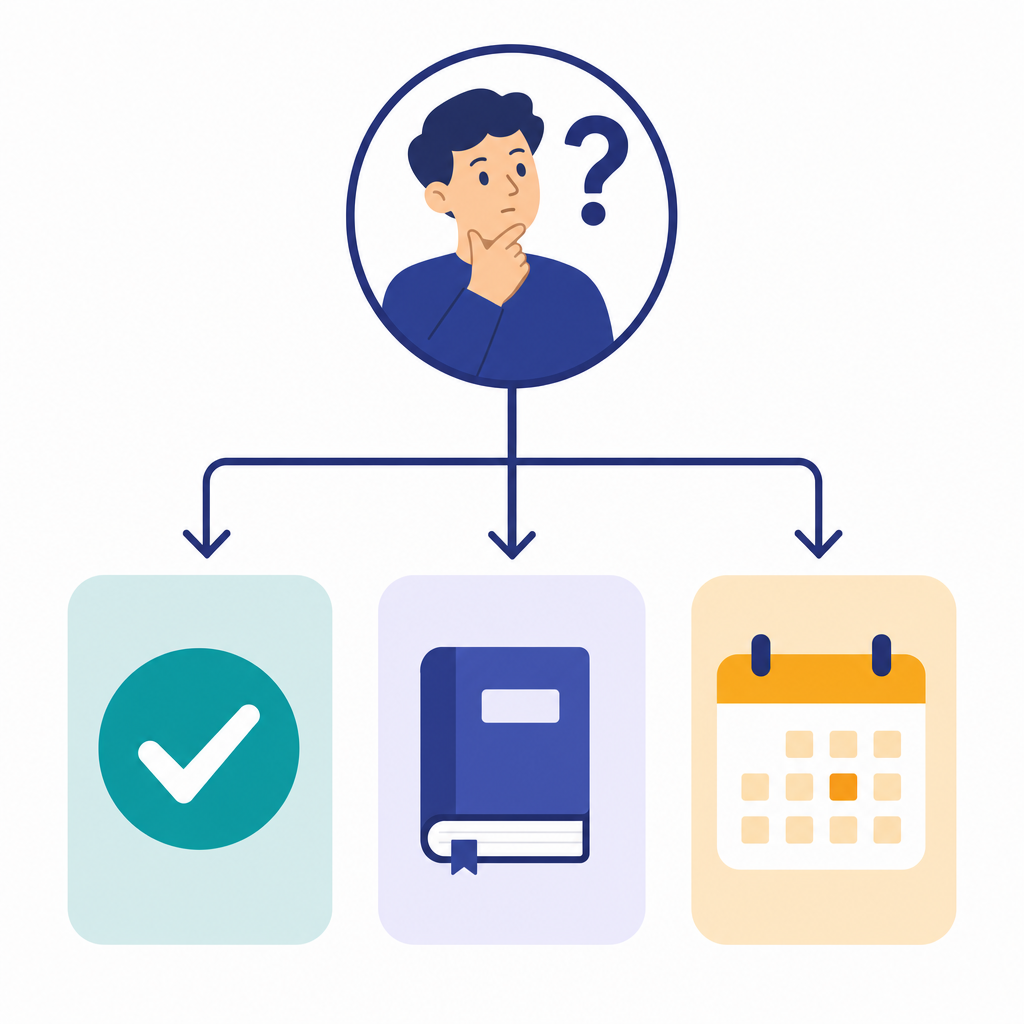
- List every nursing program you are applying to and open its admissions page.
- Note which exam each program requires, which sections are mandatory, and the minimum scores.
- If your programs require different exams, plan to prepare for both. The shared content in math, reading, and science means studying for one builds a foundation for the other.
- If a school accepts either exam, choose based on your strengths. Strong science background points to the TEAS; strong vocabulary, grammar, and recent anatomy coursework points to the HESI A2.
- Check the retake policy before test day, so you do not waste an attempt.
According to the TEAS vs HESI A2 guide from Nursing School Planner, many BSN programs use the TEAS, while schools such as Baylor and Texas A&M use the HESI A2, which shows how much the requirement varies by institution.
How to Prepare for Either Exam
Once you know which exam you are taking, the preparation strategy is the same for both:
- Confirm your exact sections and minimum scores first. For the HESI A2, never study for sections your school does not require.
- Take a timed diagnostic test to find your weakest subjects, then spend most of your study time there.
- Prioritize science and math, since they are the hardest and most heavily weighted areas on both exams.
- Practice with tests that mirror the real format and timing, not just casual quizzes.
- Leave the day before the exam free to rest. A clear head beats a last-minute cram session.
If you are taking the HESI A2, you can start with our HESI A2 prep page, which includes practice tests and mock exams built around the real section format.
Final Thoughts
The TEAS and the HESI A2 are different exams from different publishers, and you usually do not get to pick between them. Your nursing program does that for you. The most important thing you can do is check your school's requirements early, confirm the sections and minimum scores, and then study the exact material that will appear on your test. With a clear plan and consistent practice, you can walk into either exam prepared and confident.
Frequently Asked Questions
Related Posts
View all articles
CNA Measurement Questions: Intake, Output, Weight, Pulse, and Respirations
Learn how to answer CNA measurement questions on intake, output, weight, pulse, and respirations, including conversions, normal ranges, and report thresholds.

CNA Observation vs. Reporting: Which Changes in a Resident's Condition Matter Most?
Learn which changes in a resident's condition matter most for CNA observation and reporting, and how to describe them objectively so the nurse can act quickly.

CNA Delegation Questions: Knowing When to Report Instead of Acting
Learn how to answer CNA delegation questions: know your scope of practice, the five rights of delegation, and when to report to the nurse instead of acting.