CCMA Study Guide 2026: How to Pass the NHA Exam on Your First Try


Becoming a Certified Clinical Medical Assistant (CCMA) is one of the fastest ways to start a healthcare career, and the certification exam from the National Healthcareer Association (NHA) is the gate you have to walk through. The encouraging news is that most candidates make it. NHA's annual report for 2025 shows a pass rate above 81 percent, which means a well-structured study plan puts you in a strong position to join them on your first try.
This guide covers everything you need to pass the CCMA exam in 2026: the exam format and how scoring works, the seven content domains and their weights, the high-yield topics that show up again and again, an eight-week study schedule, and what to do if your first attempt does not go your way.
Use it as your roadmap. You can start by taking a diagnostic CCMA practice test to establish a baseline, then work through the plan week by week.
What Is the NHA CCMA Certification?
The Certified Clinical Medical Assistant credential is offered by the NHA and is accredited by the National Commission for Certifying Agencies (NCCA). It confirms that you can handle both sides of a medical assistant's job: the clinical work, like taking vital signs, drawing blood, running EKGs, and preparing patients, and the administrative work, like scheduling, documenting care, and managing records.
Eligibility is straightforward. You need a high school diploma or GED, plus either completion of a medical assistant training program within the last five years or one year of work experience as a medical assistant within the last three years.
CCMA Exam Format and Scoring
The CCMA exam is a computer-based test with 180 multiple-choice questions and a time limit of three hours. Of those 180 questions, 150 are scored and 30 are unscored pretest items that NHA uses to evaluate questions for future exams. You will not know which questions are pretest items, so you should answer every question as if it counts.
Your result is reported as a scaled score between 200 and 500, and you need a 390 to pass. NHA uses scaled scoring so that no candidate is penalized for receiving a slightly harder or easier version of the exam; the NHA candidate handbook explains the method in detail. In practical terms, a 390 usually works out to roughly 78 percent of the scored questions answered correctly.
Three hours for 180 questions works out to about one minute per question. That sounds generous, but scenario-based questions take longer than simple recall questions, so practicing your pacing matters from week one.
| Component | Details |
|---|---|
| Total questions | 180 (150 scored, 30 pretest) |
| Time limit | 3 hours (180 minutes) |
| Question format | Multiple choice |
| Passing score | 390 on a 200-500 scale |
| Exam fee | About $165 |
| Certification renewal | Every 2 years |
The Seven CCMA Content Domains
NHA rebuilds its test plan from a job analysis, and the current plan is based on a 2022 study of working medical assistants. It divides the 150 scored questions across seven domains, and one of them towers over the rest: Clinical Patient Care is worth 84 questions, or 56 percent of the exam. The full NHA CCMA test plan lists every task and knowledge statement that can appear on the exam, which makes it the single best outline of what to study.
| Domain | Scored Questions | Share of Exam |
|---|---|---|
| Clinical Patient Care | 84 | 56% |
| Foundational Knowledge and Basic Science | 15 | 10% |
| Patient Care Coordination and Education | 12 | 8% |
| Administrative Assisting | 12 | 8% |
| Communication and Customer Service | 12 | 8% |
| Anatomy and Physiology | 8 | 5% |
| Medical Law and Ethics | 7 | 5% |
Clinical Patient Care breaks into six subdomains, and knowing them helps you aim your study time precisely:
- Patient Intake and Vitals (14 questions): collecting chief complaints, recording histories, and measuring vital signs.
- General Patient Care (28 questions): preparing patients for exams, assisting with procedures, and helping with specimen collection.
- Infection Control and Safety (15 questions): hand hygiene, personal protective equipment, and OSHA standards.
- Point of Care Testing and Laboratory Procedures (9 questions): CLIA-waived tests and proper specimen handling.
- Phlebotomy (12 questions): venipuncture, the order of draw, and tube selection.
- EKG and Cardiovascular Testing (6 questions): lead placement and reading tracings.
Add those up and roughly 84 of your 150 scored questions come from hands-on clinical skills. The practical consequence is clear: you cannot spend your whole study window on anatomy and terminology. The exam rewards assistants who know how patient care actually happens in a clinic.
CCMA Study Plan: 8 Weeks to Exam Day
A realistic prep window is six to eight weeks. The schedule below mirrors the domain weights, so your time investment matches your score potential.
- Week 1: Learn the format. Read the test plan, take a diagnostic practice test, and note your weakest domains.
- Weeks 2-3: Master the foundations. Study medical terminology, anatomy and physiology, basic pharmacology, and the administrative domains.
- Weeks 4-5: Go deep on clinical patient care. This is the 56 percent domain, so give it the most time. Drill vital signs, infection control, specimen handling, and patient preparation.
- Week 6: Phlebotomy and EKG week. Memorize the order of draw and tube colors, practice lead placement, and review common tracing artifacts.
- Week 7: Full-length practice exams. Take two timed tests under real conditions, then review every missed question.
- Week 8: Targeted review. Revisit the domains your practice scores flag as weak, and take one final practice exam before test day.
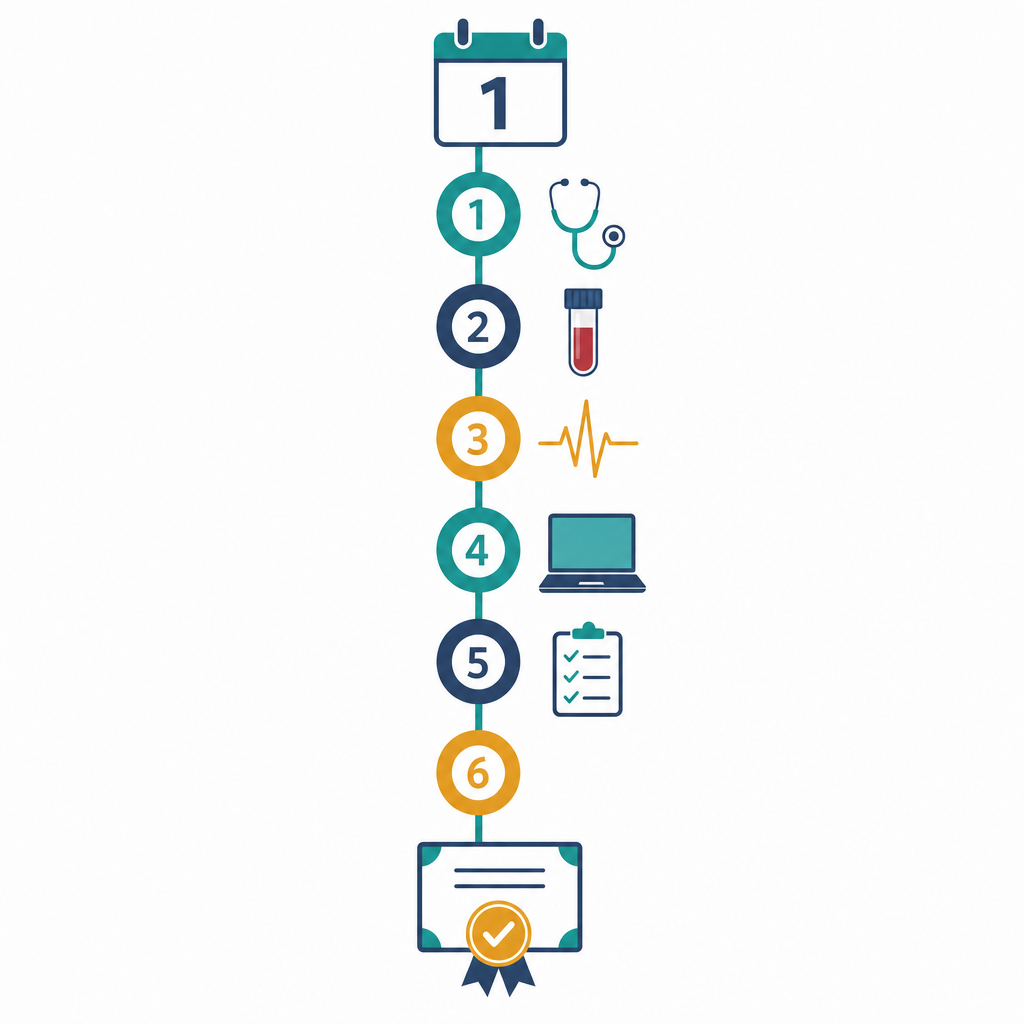
Figure 1. The eight-week CCMA study timeline, from a diagnostic practice test in week one to full-length practice exams and targeted review in the final weeks.
High-Yield Topics to Focus On
Across every domain, a handful of topics appear again and again. Drill these until they are automatic:
- Normal vital sign ranges for adults, and when to report an abnormal reading
- The order of draw for phlebotomy and which tube tops match which tests
- EKG lead placement and how to spot artifact on a tracing
- HIPAA privacy rules, informed consent, and scope of practice
- Medical terminology prefixes and suffixes, which unlock dozens of questions
- Common medications, including routes, side effects, and safety checks
- ICD-10 and CPT coding basics for billing questions
Memorizing normal vital signs is one of the quickest wins on the whole exam. Questions that ask whether a reading is normal become easy, and you will be confident flagging an abnormal result for the provider.
| Vital Sign | Normal Adult Range |
|---|---|
| Temperature | 36.5-37.5 C (97.7-99.5 F) |
| Pulse | 60-100 beats per minute |
| Respirations | 12-20 breaths per minute |
| Blood pressure | Less than 120/80 mm Hg |
| Oxygen saturation | 95-100% |
How to Use Practice Tests Effectively
The fastest way to raise your score is to practice under exam conditions. Take timed, full-length tests that mirror the real format, then spend at least as long reviewing your mistakes as you spent taking the test. For every wrong answer, ask yourself three questions: did I misread the question, did I miss the concept, or did I run out of time?
Many CCMA questions describe a scenario and ask what the assistant should do first, next, or best. When two answers seem correct, re-read the question and focus on its key words, because the intended answer changes with first, next, best, and except. The same reading strategy that works for other NHA exams applies here, including the approach in our guide to answering questions when two answers seem correct.
Track your accuracy by domain, not just your total score. If your practice scores show Communication and Customer Service at 40 percent while Clinical Patient Care sits at 80 percent, you know exactly where the final weeks should go.
What Happens If You Don't Pass: The Retake Policy
Even with a strong plan, some candidates come up short on the first attempt. The NHA's policy gives you room to recover. You can retake the exam after a 30-day waiting period following a first or second unsuccessful attempt, and you must wait 12 months after a third unsuccessful attempt. Every retake requires a new registration and the full exam fee, so it pays to use the waiting window for real study. NHA's own guidance on what to do after a failed exam recommends exactly that.
Your score report breaks your performance down by content area, which tells you precisely which domains to review before re-registering. Most candidates who fail do so because of one or two weak domains, not because they lack overall knowledge.
Final Thoughts
The CCMA exam is broad but predictable. Master the clinical skills that make up 56 percent of the test, memorize the high-yield facts, take timed practice exams, and review your mistakes systematically. That formula, repeated for six to eight weeks, is what separates first-attempt passers from everyone else.
Set a test date early, work your plan week by week, and trust the process. When you walk out of the testing center with a passing score, you will hold a credential that opens doors in clinics, hospitals, and specialty practices across the country.
Frequently Asked Questions
Related Posts
View all articles
CNA Measurement Questions: Intake, Output, Weight, Pulse, and Respirations
Learn how to answer CNA measurement questions on intake, output, weight, pulse, and respirations, including conversions, normal ranges, and report thresholds.

CNA Observation vs. Reporting: Which Changes in a Resident's Condition Matter Most?
Learn which changes in a resident's condition matter most for CNA observation and reporting, and how to describe them objectively so the nurse can act quickly.

CNA Delegation Questions: Knowing When to Report Instead of Acting
Learn how to answer CNA delegation questions: know your scope of practice, the five rights of delegation, and when to report to the nurse instead of acting.