CNA Measurement Questions: Intake, Output, Weight, Pulse, and Respirations

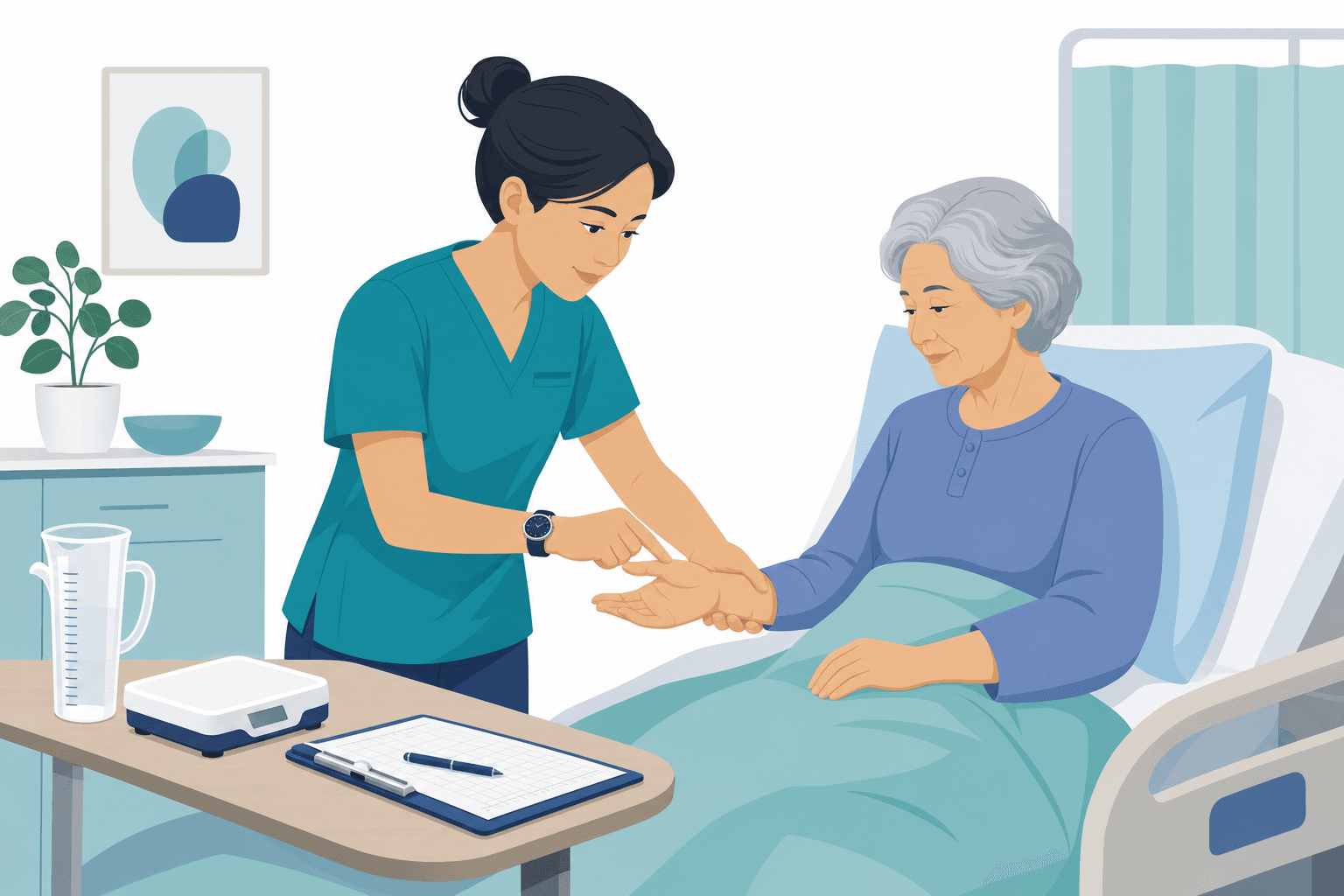
Measurement questions are the most concrete questions on the CNA written exam, and they are also the most forgiving. Nothing on this topic is a judgment call. You either know the conversion, the normal range, or the report threshold, or you do not. That makes it one of the fastest sections to master, and one of the safest points on your score.
This guide covers everything the exam throws at you on intake and output, weight, pulse, and respirations: the conversions to memorize, the measurement techniques the test assumes you know, and the values that must be reported to the nurse. Practice links are included at the end.
Intake and Output Basics
Intake and output, usually written as I&O, tracks the fluids that enter and leave a resident's body over a shift. Intake includes everything the resident drinks, plus fluids that become liquid at body temperature, like soup, gelatin, ice cream, and ice chips. Output includes urine, vomit, and wound drainage when the nurse orders it measured. Solid food is not counted as intake.
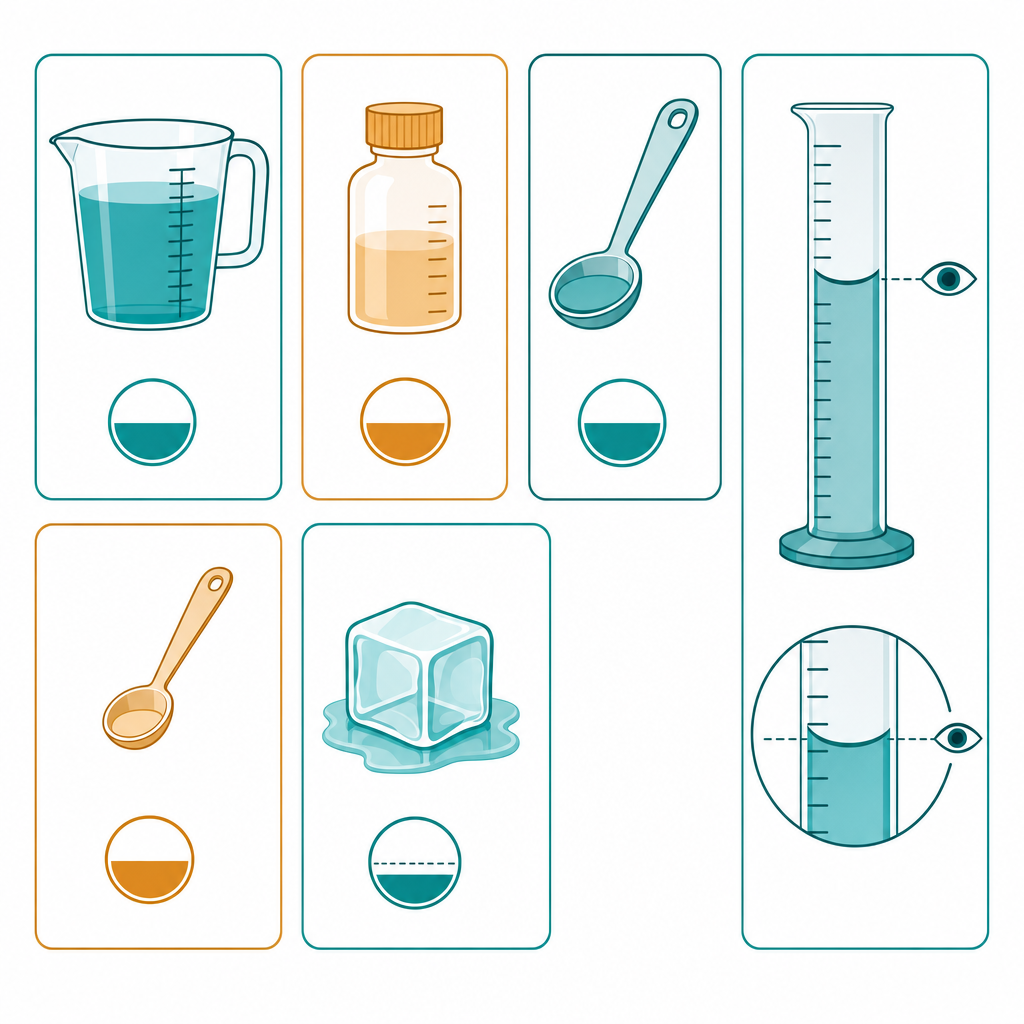
Two details trip up students more than anything else. First, record only what the resident actually consumed, not what was served. Second, record everything in milliliters (mL), never in ounces or cups. The measurement itself, taken at eye level on a flat surface, should be read at the bottom of the liquid's curve, the meniscus.
Conversions You Must Know
The exam will hand you a tray described in ounces and ask for the total in mL. These five equivalents cover every question you will see:
| Container | Volume | Milliliters |
|---|---|---|
| 1 fluid ounce | 1 oz | 30 mL |
| 1 cup | 8 oz | 240 mL |
| 1 tablespoon | 1 tbsp | 15 mL |
| 1 teaspoon | 1 tsp | 5 mL |
| Ice chips | 8 oz cup | 120 mL (half the volume) |
Here is the classic exam example. A resident drank half of a 6 oz glass of juice, 4 oz of milk, and 8 oz of coffee. Half of 6 oz is 3 oz, and 3 oz at 30 mL each is 90 mL. The milk is 120 mL and the coffee is 240 mL. The total is 450 mL. Read the words "half of" twice on questions like this one; it is the most common trap in the whole topic.
Measuring Output Correctly
When you measure urine, the technique matters as much as the number. Pour the urine into a graduated container, set it on a flat surface, and read the volume at eye level at the bottom of the meniscus. Record the amount in mL with the time, and take a moment to note the color, clarity, and odor before you pour it out. Unusual appearance is a clinical finding the nurse needs to know about.
Report low output promptly: less than 30 mL per hour or less than 240 mL over an 8-hour shift. Low output can signal dehydration, urinary retention, or kidney trouble, and the nurse decides what it means. You measure, you record, you report.
- Report output below 30 mL per hour or below 240 mL over an 8-hour shift.
- Report unusual urine color, clarity, or odor along with the volume.
- Record the measurement before the urine is discarded, and note the time.
Measuring Weight
Weight is a daily responsibility for many aides, and the exam tests the consistency rules that make weight meaningful. Weigh the resident at the same time each day, on the same scale, and in similar clothing, with shoes off. Zero the scale before the resident steps on, help them step to the center of the platform, and stay close while they step on and off, since falls happen on and off the scale more than on it.
Report significant changes to the nurse: a gain or loss of 2 or more pounds in 24 hours, or 5 or more pounds in a week. Rapid gain can signal fluid retention, and rapid loss can signal poor intake or illness. The step-by-step checklist from the Wisconsin Technical College nursing assistant open textbook shows exactly how the skill is evaluated.
Counting Pulse and Respirations
Pulse and respirations are usually measured together, and the technique is easy to get wrong under pressure. For the pulse, use your index and middle fingers at the wrist, never your thumb, which has a pulse of its own. Count for a full 60 seconds, or for 30 seconds and multiply by two when the rhythm is clearly regular. On the exam, a full minute is the safe choice. Note the rate, the rhythm, and the strength.
Then transition straight into respirations without telling the resident you are counting breaths. People change how they breathe when they know they are being watched. Keep your fingers on the wrist and watch the chest rise and fall; one breath is one complete rise and one fall. Count for a full minute and note the rate, depth, and rhythm. The normal ranges and measurement steps are laid out in the LibreTexts Nursing Assistant open textbook chapter on normal vital sign ranges.
Normal Ranges and Report Thresholds
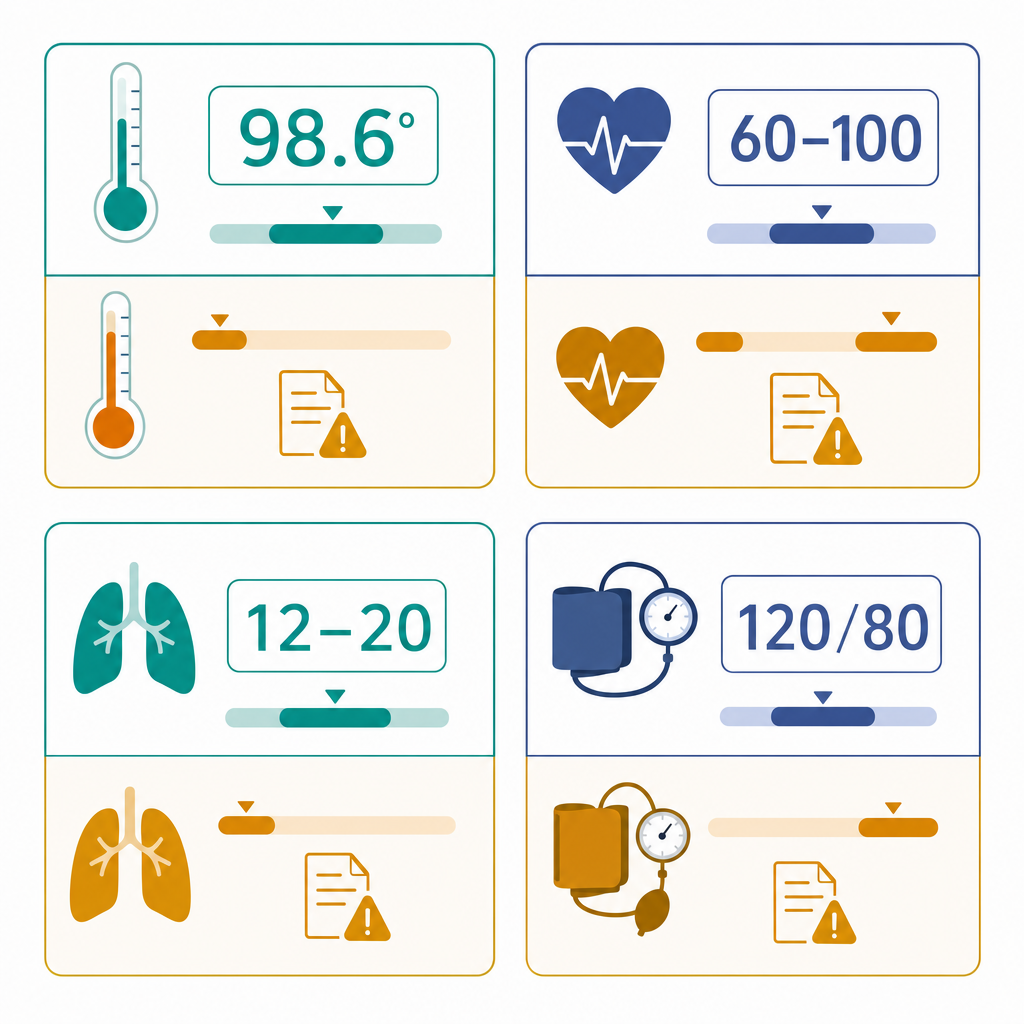
You do not need to interpret a reading, but you do need to know when one is out of range. These are the adult values the exam uses:
| Measurement | Normal range | Report to the nurse if |
|---|---|---|
| Pulse | 60 to 100 beats per minute | Below 60 or above 100, or irregular |
| Respirations | 12 to 20 breaths per minute | Below 12 or above 20, or labored |
| Temperature (oral) | 97.6 to 99.6 degrees F | Above 100.4 degrees F |
| Blood pressure | Around 120/80 mmHg | Consistently above 130/90 |
The MedlinePlus reference on pulse rate, published by the National Library of Medicine, is a reliable place to confirm the ranges if you want a second source. Above all, compare every reading to the resident's own baseline: a pulse of 92 is reportable for a resident whose usual pulse is 70, even though 92 is inside the normal range. The change is the signal.
Practice the Math and the Ranges
Measurement questions are perfect for practice tests because they repeat. Work the conversions and ranges on the free CNA Physical Care Skills practice test, then take the full-length CNA mock exam to keep the numbers fresh under time pressure. When you miss one, write the rule on an index card: it will be a free point next time.
Remember that a measurement is also an observation. The rules for reporting changes from baseline in our guide to observation vs. reporting apply to numbers too, and the reading strategies in our guide to tricky CNA questions will help you catch the traps baked into the word problems.
Final Thoughts
Measurement questions reward preparation more than any other section. Memorize the five conversions, the normal ranges, and the report thresholds, and the technique points: eye level, full minute, thumb off the pulse, and ice counted at half volume. That is the whole section in one paragraph.
Drill these numbers until they are automatic, and measurement questions will be the points you can count on.
Frequently Asked Questions
Related Posts
View all articles
CNA Observation vs. Reporting: Which Changes in a Resident's Condition Matter Most?
Learn which changes in a resident's condition matter most for CNA observation and reporting, and how to describe them objectively so the nurse can act quickly.

CNA Delegation Questions: Knowing When to Report Instead of Acting
Learn how to answer CNA delegation questions: know your scope of practice, the five rights of delegation, and when to report to the nurse instead of acting.
CNA Priority Questions: How to Decide What the Nurse Aide Should Do First
Learn how to answer CNA priority questions by using the ABCs, Maslow's hierarchy, and a simple safety-first order to decide what the nurse aide should do first.